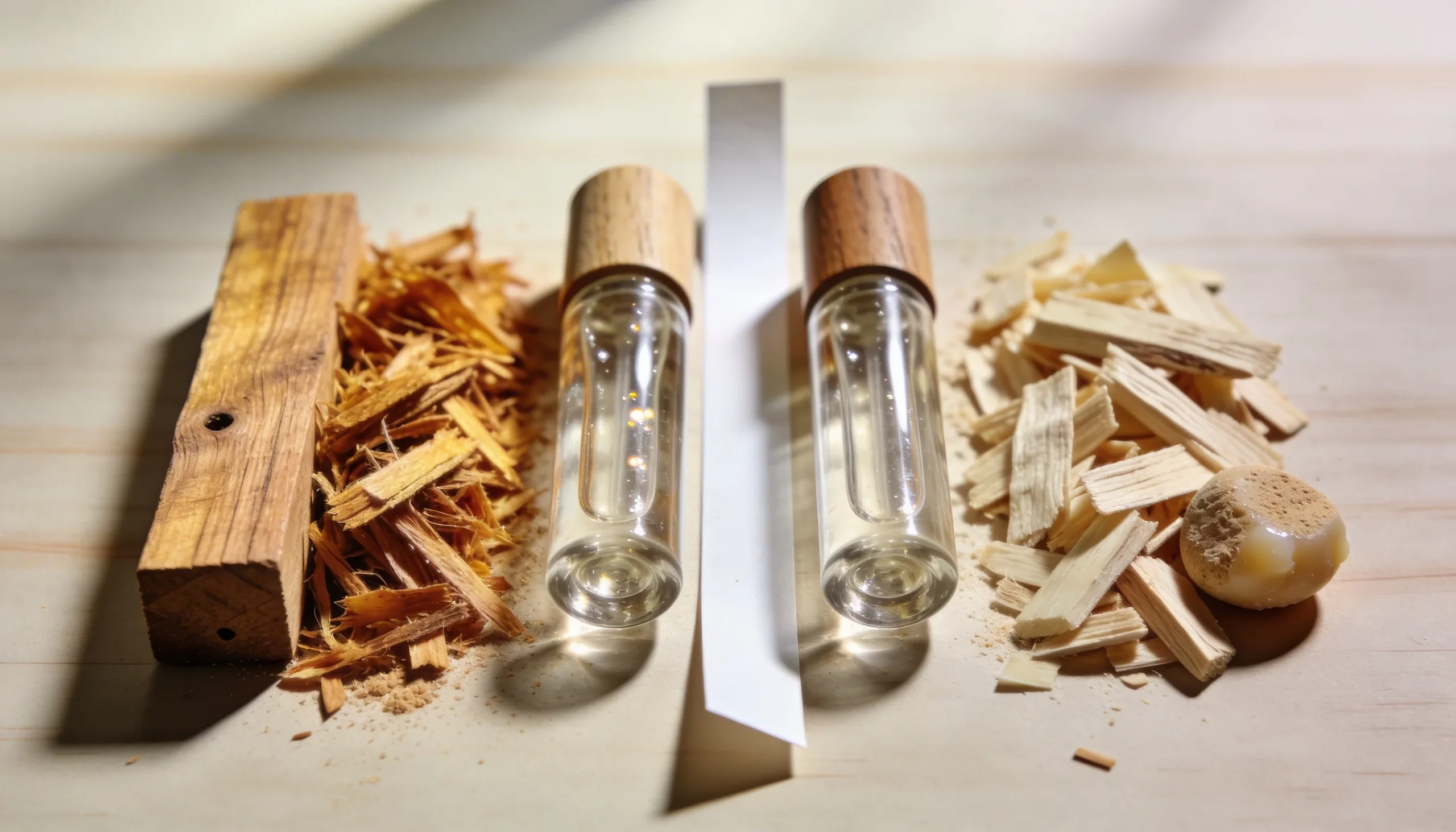
teakwood vs sandalwood scent


Teakwood vs sandalwood scent: key differences, similarities, and how to choose

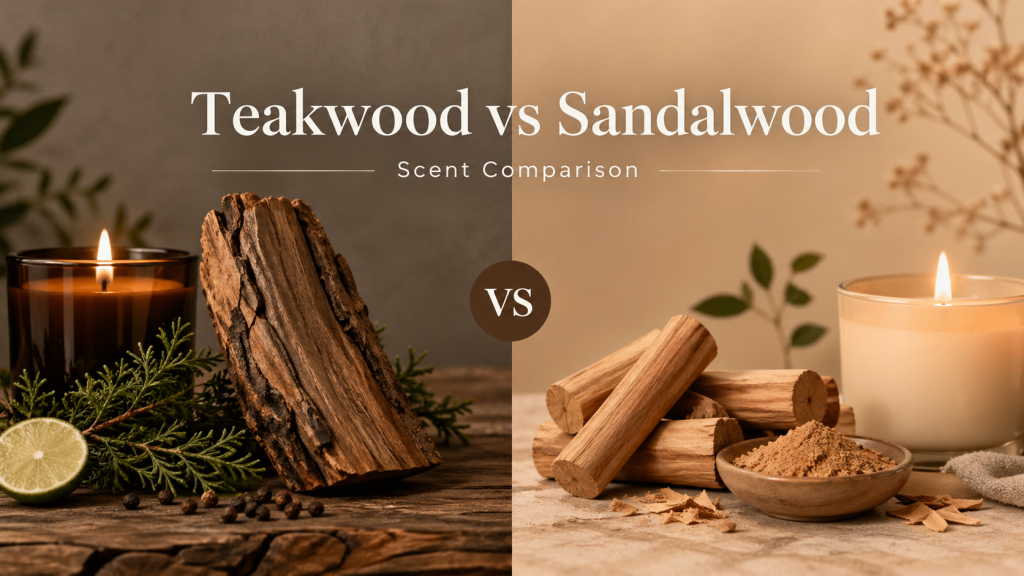
Choosing between teakwood vs sandalwood scent often comes down to how you like your “woodiness” to feel: crisp and structured, or smooth and comforting. Both are popular in candles, diffusers, soaps, and personal fragrance because they sit beautifully in the base of a blend and create an instantly grounded vibe. But despite being grouped together as woody profiles, teakwood and sandalwood usually deliver very different impressions in real-world products.

This guide breaks down what each scent typically smells like, where they overlap, how they perform across formats, and how to test and choose the right one for your space or skin.

Teakwood vs sandalwood scent at a glance

Quick comparison summary

Trait Teakwood scent (typical) Sandalwood scent (typical)
Overall vibe Dry, polished, “clean wood” Creamy, smooth, cozy wood
Texture Sharper edges, structured Velvety, rounded
Sweetness Low to moderate; often understated Moderate; often feels richer
Common companions Citrus, spice, smoke, leather, musk Vanilla, amber, iris, musk, gentle spice
Room presence Often more assertive and “fresh-woody” Often softer, warmer, more enveloping
Best for Modern, clean, confident atmospheres Relaxing, comforting, intimate atmospheres

Who tends to prefer teakwood scent vs sandalwood scent

Preferences vary, but patterns show up across product reviews and scent families:

  • Teakwood lovers often gravitate toward crisp woods, barbershop-clean blends, fresh-spicy profiles, and “modern cabin” vibes that feel airy rather than sweet.
  • Sandalwood lovers often prefer comforting woods, creamy ambers, soft musks, and warm skin-scent styles that feel smooth and soothing.

When teakwood vs sandalwood scent can smell similar

Teakwood and sandalwood can overlap when they’re used as supportive base notes rather than the star. They may smell similar if:

  • The product uses a woody-musky base where both read as “clean wood” behind brighter notes.
  • The blend includes amber, vanilla, or tonka, which can soften teakwood and push it closer to sandalwood’s warmth.
  • The format is subtle (for example, a lightly scented lotion), making differences harder to detect.

What “teakwood scent” typically smells like

Core scent profile and dominant impressions

Teakwood scent typically reads as dry, smooth, and refined—a modern take on wood rather than a raw, sawdust-style note. Many teakwood-labeled products aim for a “freshly finished wood” impression: clean, slightly aromatic, and confidently woody.

Common dominant impressions include:

  • Dry woods with a crisp, structured feel
  • Clean, slightly airy “fresh-woody” character
  • Subtle spice or warmth that adds depth without turning sugary

Secondary nuances and common undertones

Because “teakwood” is often an accord (a constructed profile) rather than a literal single-ingredient smell, the undertones can shift by brand. Teakwood is frequently supported by:

  • Spice (peppery or clove-like facets)
  • Leather or suede nuances for ruggedness
  • Smoke or charred edges for depth
  • Musk for a clean, lingering finish
  • Citrus (bergamot, grapefruit) to brighten the opening

How teakwood scent reads in different concentrations

Teakwood’s dryness can become either elegantly crisp or overly sharp depending on strength:

  • Light concentration: airy clean-wood backdrop; reads fresh and minimalist.
  • Medium concentration: clearly woody, slightly spicy, and more “masculine-leaning” to many noses.
  • High concentration: can feel bold and commanding; may emphasize sharpness, smoke, or leather facets depending on the formula.

How teakwood scent develops over time (opening → dry-down)

Teakwood blends often open with brightness and settle into a drier base:

  • Opening: fresh or aromatic lift (often citrus or clean spice)
  • Mid: woody heart becomes more prominent; subtle warmth builds
  • Dry-down: dry woods and musk linger; any smoky/leathery tones become more noticeable

What “sandalwood scent” typically smells like

Core scent profile and dominant impressions

Sandalwood scent typically reads as creamy, smooth, and softly warm. Instead of a sharp, plank-like wood, sandalwood tends to feel like a velvety, skin-adjacent warmth—often described as milky, soft, and calming.

Common dominant impressions include:

  • Creamy wood with a rounded, comforting texture
  • Soft warmth that feels cozy rather than spicy-hot
  • Gentle richness that can lean slightly sweet

Secondary nuances and common undertones

Sandalwood accords vary widely, but many share a smooth base supported by:

  • Amber for warmth and glow
  • Vanilla or tonka-like sweetness for a cozy feel
  • Musk for a clean, soft “skin” finish
  • Powdery or floral hints (like iris-like softness) in some blends
  • Subtle spice that remains rounded, not sharp

How sandalwood scent reads in different concentrations

Sandalwood is often forgiving, but concentration still changes the experience:

  • Light concentration: soft, clean creaminess; often reads as “your space but warmer.”
  • Medium concentration: clearly sandalwood-forward; cozy and polished, with a plush base.
  • High concentration: can become very rich and enveloping; may lean sweet, musky, or slightly powdery depending on the formula.

How sandalwood scent develops over time (opening → dry-down)

Sandalwood often feels smooth from the start, then deepens into warmth:

  • Opening: gentle, soft, sometimes slightly fresh or lightly sweet
  • Mid: creamy woods expand; amber/musk supports a rounded heart
  • Dry-down: lingering smoothness; warm, close-wearing “comfort wood” effect

Teakwood vs sandalwood scent: detailed comparison

Warmth and creaminess

In teakwood vs sandalwood scent, this is one of the most noticeable differences. Teakwood can be warm, but it’s usually a drier warmth. Sandalwood is typically creamy-warm—like warmth with a soft blanket effect.

Dryness vs softness

Teakwood tends to read drier and more angular, which many people interpret as “clean” or “rugged.” Sandalwood leans soft and rounded, often blending seamlessly into other notes.

Sweetness level and perceived richness

Teakwood profiles often keep sweetness restrained. Sandalwood can feel richer even when it isn’t very sweet, simply because the creamy texture reads as fuller and more luxurious.

Freshness vs smokiness

Teakwood commonly sits closer to fresh-woody (especially if paired with citrus, herbs, or clean musk), but it can also pick up smokiness when blended with charred notes. Sandalwood is less “fresh” and more “warm,” though it can be paired with fresh top notes to brighten it without losing its smooth base.

Clean vs earthy character

Teakwood often comes across as clean, polished, and modern. Sandalwood can feel clean too, but it’s more likely to read as softly earthy or warmly grounded rather than crisp.

Intensity and projection

Many teakwood blends project as more assertive, especially in home fragrance. Sandalwood often feels more close and enveloping, creating a “halo” rather than a sharp throw—though strong formulas exist in both directions.

Longevity and staying power

Both teakwood and sandalwood are commonly used as base-leaning profiles, so they tend to last. Perceived staying power depends heavily on concentration and carrier (wax, alcohol, oil, soap base). Teakwood may feel like it “sticks” because its drier edges remain noticeable, while sandalwood can seem to fade faster simply because it blends into the background more smoothly.

Versatility across settings and seasons

For everyday versatility, both work well, but they shine in different moments:

  • Teakwood: great for offices, entryways, modern living spaces, and anytime you want crisp confidence.
  • Sandalwood: great for bedrooms, relaxation routines, cozy living spaces, and anytime you want softness.

Seasonally, teakwood often feels natural in spring/fall and even summer if it leans fresh, while sandalwood feels especially at home in fall/winter and nighttime use.

Layering compatibility with other scent families

Teakwood plays well with citrus, aromatic, spicy, leathery, and smoky families. Sandalwood layers beautifully with amber, vanilla/gourmand-leaning warmth, soft florals, and musks. If you like mixing scents, sandalwood is often the smoother “glue,” while teakwood adds structure and definition.

Teakwood vs sandalwood scent by format and use-case

Scented wax, oils, and diffusers

In diffusers and oils, teakwood vs sandalwood scent can separate clearly. Teakwood oils often read sharper and more present in the air, while sandalwood oils can feel rounder and calmer. If you want a noticeable “walk into the room and smell it” effect, teakwood-leaning blends often get there faster. If you want continuous background comfort, sandalwood often excels.

Candles

Candles can amplify warmth. Teakwood candles frequently smell like a clean, upscale wood with a little spice or smoke. Sandalwood candles often feel creamy and cozy, sometimes with amber-like richness. Hot throw varies by wax blend and fragrance load, so a sandalwood candle can still be powerful—it just tends to feel less sharp at the edges.

Personal fragrance formats (sprays, roll-ons, balms)

On skin, teakwood can become more musky and dry, sometimes leaning “cologne-like” depending on the blend. Sandalwood often reads more intimate and skin-soft. Roll-ons and balms can make both feel denser and longer-lasting, with sandalwood especially benefiting from the warmth of skin to bring out its creamy facets.

Soaps and wash-off products

In soaps and body wash, top notes can dominate and bases can be muted. Teakwood often keeps its clean-woody identity even in rinse-off formats. Sandalwood can skew more “clean creamy” and may feel subtler unless the formula is strong or supported by amber/musk.

Lotions and leave-on products

Lotions tend to soften edges. Teakwood may become smoother and less sharp, reading like polished wood with a clean musk base. Sandalwood often becomes especially comforting here—creamy, warm, and close-wearing.

Home scenting vs on-skin scenting (perception differences)

In rooms, teakwood often feels more architectural: it defines space with crisp woody lines. Sandalwood often feels atmospheric: it fills space with warmth. On skin, teakwood can feel more “fresh-woody,” while sandalwood can feel more “warm-skin” depending on the blend and your body chemistry.

How to choose between teakwood vs sandalwood scent

Choose teakwood scent if you prefer…

  • Drier woods with a clean, modern feel
  • Sharper definition rather than creamy softness
  • Fresh-spicy or subtly smoky accents
  • More noticeable projection in home scenting

Choose sandalwood scent if you prefer…

  • Creamy, smooth woods that feel cozy and calming
  • Soft warmth with a more intimate presence
  • Richer bases that pair well with amber, vanilla, and musk
  • A gentler woody profile that’s less sharp to the nose

Choose based on mood and atmosphere goals

  • Focus and clarity: teakwood often supports a crisp, put-together mood.
  • Rest and comfort: sandalwood often supports unwind time and cozy routines.
  • Elevated “hotel lobby” vibes: teakwood blends frequently deliver that polished freshness.
  • Soft luxury and calm: sandalwood leans spa-like and soothing.

Choose based on seasonality preferences

  • Warmer months: teakwood (especially with citrus/aromatic notes) can feel cleaner and lighter.
  • Colder months: sandalwood tends to feel warmer and more cocooning.
  • Year-round: both can work, especially when balanced with complementary notes.

Choose based on sensitivity to stronger woody notes

If you’re sensitive to bold woody sharpness, sandalwood is often the safer pick because it’s typically smoother and less piercing. If sandalwood turns too sweet, too dense, or too “soft-focus” for you, teakwood may feel clearer and more breathable.

If you want a “wood” scent that feels…

Cleaner and drier

Lean toward teakwood. Look for descriptions like “crisp,” “clean woods,” “fresh,” “spiced,” “modern,” or “musk-forward.”

Creamier and smoother

Lean toward sandalwood. Look for “creamy,” “soft,” “velvety,” “milky,” “warm musk,” or “ambered.”

Darker and more resinous

Either can work depending on what it’s blended with, but many people find teakwood goes darker more easily when paired with smoke/leather/amber, while sandalwood goes darker when paired with deeper amber and musk. Check for “smoky,” “incense,” “resin,” or “amber” descriptors on the label.

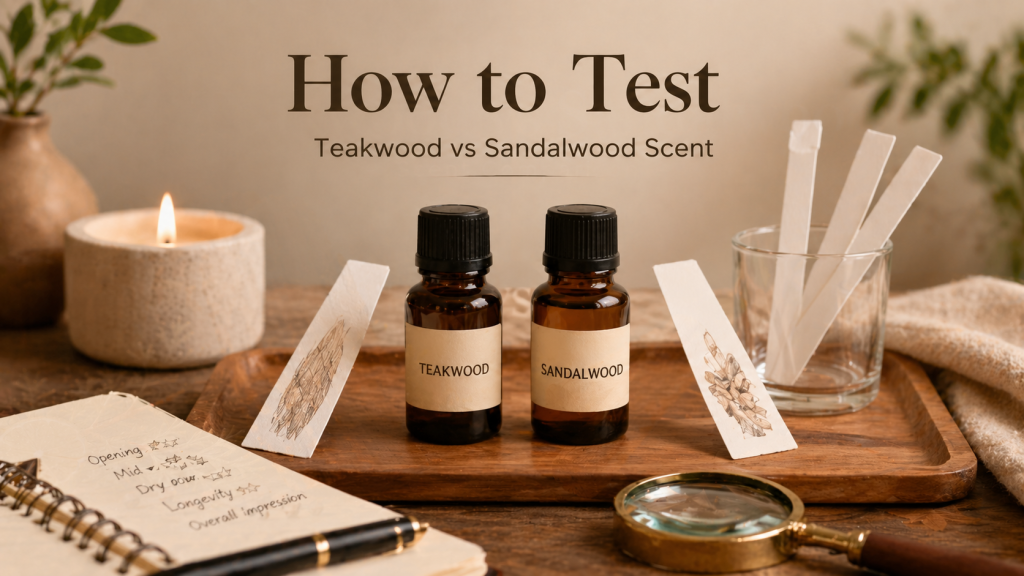
Testing teakwood vs sandalwood scent before committing

Smelling strip vs on-skin vs in-room testing

  • Smelling strip (or blotter): best for first impressions and comparing openings side-by-side without skin chemistry.
  • On-skin: best for personal fragrance; sandalwood often gets creamier on skin, while teakwood can become drier and musky.
  • In-room: best for candles/diffusers; airflow and room size strongly affect how intense each feels.

How long to wait to evaluate the dry-down

For personal fragrance, give each at least 30–60 minutes to reach a true dry-down, and ideally check again at 2–4 hours. For candles and diffusers, allow time for the scent to settle into the space—often 20–40 minutes depending on the format and ventilation.

Avoiding scent fatigue during comparisons

  • Compare no more than 2–3 scents in one session.
  • Take breaks in fresh air between tests.
  • Test at different times of day; what feels smooth at night can feel heavy in the morning.

Checklist for side-by-side evaluation

  1. Opening: which feels more pleasant in the first 1–5 minutes?
  2. Mid: after 15–30 minutes, does it turn sharp, sweet, smoky, or powdery?
  3. Dry-down: after 1–2 hours, which feels more wearable or livable?
  4. Projection: do you want it noticeable across the room, or close and subtle?
  5. After-scent: does it leave a clean impression or a heavy residue feeling?
  6. Compatibility: does it clash with your existing products (laundry detergent, shampoo, room sprays)?

Blending and pairing: teakwood vs sandalwood scent

Notes that commonly complement teakwood scent

  • Citrus: bergamot, grapefruit, lemon peel for lift
  • Aromatics: lavender, rosemary-like freshness for a clean vibe
  • Spice: black pepper, cardamom-style warmth for structure
  • Smoke/leather: for a darker, rugged edge
  • Musk: to smooth the dry wood and extend the base

Notes that commonly complement sandalwood scent

  • Amber: for glow and depth
  • Vanilla/tonka-style warmth: for cozy richness
  • Soft florals: to add elegance without sharpness
  • Musk: for a clean, skin-like finish
  • Gentle spice: for warmth without turning the blend harsh

Building a balanced “woody” blend (structure headings)

Top-note choices

  • For teakwood blends: fresh citrus or aromatic brightness to keep it crisp
  • For sandalwood blends: light freshness or subtle sweetness to keep it airy

Heart-note choices

  • For teakwood blends: clean spice or aromatic facets to add body
  • For sandalwood blends: ambered warmth or soft floral nuances for smoothness

Base-note choices

  • For teakwood blends: musk, smoke, leather-leaning depth for longevity
  • For sandalwood blends: amber, musk, gentle sweetness for a creamy trail

Avoiding clashes when mixing woody profiles

  • Go light on smoke if you want the wood to stay clean; smoke can dominate both teakwood and sandalwood.
  • Be cautious with powdery notes if you dislike “cosmetic” softness; they can shift sandalwood in that direction.
  • Don’t stack too many heavy bases at once (multiple musks + amber + woods) or the blend can feel flat and congested.
  • When layering teakwood and sandalwood together, start with a 2:1 ratio (whichever you want dominant), then adjust.

Cost, availability, and considerations (as they relate to teakwood vs sandalwood scent)

Price differences across scent sources and formats

Pricing for teakwood vs sandalwood scent varies more by brand positioning and format than by the name alone. In general, woody profiles are widely available and often priced as mid-range staples in home fragrance. Personal fragrance versions can range from affordable to premium depending on concentration and branding.

Variability between products labeled “teakwood” or “sandalwood”

Two products with the same label can smell dramatically different. “Teakwood” might lean fresh-spicy in one product and smoky-leathery in another. “Sandalwood” might be creamy-clean in one formula and amber-sweet in another. Always read the supporting note descriptions to understand which direction the blend takes.

Consistency issues across batches and brands

Woody accords can shift slightly across batches due to supplier changes, reformulations, or small differences in how fragrance is dosed into wax, soap base, or carrier oil. If you find a version you love, consider noting the exact product name, concentration, and format for easier repurchasing.

Potential sensitivity and irritation considerations

Strong woody blends can be intense for sensitive noses, especially if they include spice, smoke, or heavy musks. For on-skin use, patch test leave-on products and avoid over-applying until you know how the formula wears. For home scenting, start with shorter burn/diffusion times and ventilate the space.

Storage and shelf-life factors that can alter scent

Heat, light, and oxygen can dull top notes and make woody bases feel heavier over time. Store fragrance oils, sprays, and candles away from direct sunlight and high heat. If a teakwood or sandalwood product starts smelling flatter, sharper, or “off,” storage conditions may be a factor.

Common mistakes when comparing teakwood vs sandalwood scent

Judging too early (before dry-down)

A quick sniff can mislead you, especially for woody profiles that bloom later. Teakwood may start bright and turn deeper; sandalwood may start subtle and become creamier with time. Always compare after the scent has settled.

Comparing across different formats without accounting for strength

A teakwood candle versus a sandalwood body lotion is not a fair fight. Format changes intensity, throw, and how notes are perceived. When possible, compare like-for-like (candle vs candle, oil vs oil, spray vs spray).

Over-layering and masking woody nuances

Layering is helpful, but too many products at once can blur the differences you’re trying to evaluate. Keep other scented products minimal (hand soap, room spray, laundry scent boosters) during testing.

Confusing “woody” with “smoky” or “powdery”

Some blends labeled teakwood are smoky; some sandalwood blends are powdery. If you dislike smoke, avoid “charred,” “embers,” or “tobacco” cues. If you dislike powder, be cautious with “soft,” “cashmere,” or “powdery” descriptions that can push sandalwood in that direction.

FAQ: Teakwood vs sandalwood scent

Q: What is the main difference between teakwood vs sandalwood scent?
A: Teakwood scent typically reads drier and sharper, while sandalwood scent typically reads smoother and creamier, with a softer overall impression.

Q: Is teakwood scent stronger than sandalwood scent?
A: It depends on the product concentration and format, but teakwood profiles often project as more assertive, while sandalwood profiles often feel more rounded and close-wearing.

Q: Which lasts longer: teakwood vs sandalwood scent?
A: Longevity varies by formulation and medium; both can last well as base-leaning woody profiles, with perceived staying power influenced by concentration and how the scent is delivered.

Q: Do teakwood vs sandalwood scent smell similar?
A: They can overlap as “woody” profiles, but teakwood generally skews drier and more rugged, while sandalwood generally skews creamier and more velvety.

Q: Which is better for a cozy scent: teakwood vs sandalwood scent?
A: Sandalwood scent is often perceived as cozier due to its smoother, creamier character, though teakwood can feel cozy when blended to soften its dryness.

Q: Which is better for a clean, crisp woody vibe: teakwood vs sandalwood scent?
A: Teakwood scent typically aligns more with a clean, crisp woody impression, depending on how it’s composed in the product.

Q: How can I choose teakwood vs sandalwood scent without smelling in person?
A: Look for descriptions that emphasize “dry/crisp/robust” for teakwood and “creamy/soft/smooth” for sandalwood, and prioritize smaller sizes or sampler options when available.

Q: Can I layer teakwood vs sandalwood scent together?
A: Yes; layering can create a balanced woody profile, with teakwood adding structure and sandalwood adding smoothness, but start lightly to avoid overpowering the blend.

Final decision guide: teakwood vs sandalwood scent

Best pick if you want a drier, more rugged wood

Choose teakwood. It typically delivers a crisp, structured wood profile that feels modern, confident, and more defined in the air.

Best pick if you want a smoother, creamier wood

Choose sandalwood. It typically offers a softer, creamier, more comforting woodiness that feels cozy and calming.

Best pick if you want a versatile everyday woody profile

If you want a woody scent that works almost anywhere, pick based on your preference for texture: teakwood for clean and crisp daily energy, or sandalwood for soft warmth that blends effortlessly into most spaces and routines.

Best pick if you’re sensitive to strong woody sharpness

Choose sandalwood first. Its smoother profile is often easier to live with for long periods, especially in bedrooms, small rooms, or close-wearing personal fragrance.

No comment

Leave a Reply

Your email address will not be published. Required fields are marked *